
WATER ETECH SOLUTIONS
Benefits which can be delivered by each effect of WTS
Three main effects mentioned can deliver the following significant effects:
- 1) EFFECT A (Change of the water structure)
- Remove the existing scale and rust by significantly higher osmotic pressure.
- Treated water goes so deeply and effectively into the cells of humans, animals and plants, which can make it possible for them to absorb water so efficiently. This could lead to antioxidant effects.
- 2) EFFECT B (Change of ionized minerals into tiny soft colloids)
- Prevent the formation of scale.
- 3) EFFECT C (Cationized water)
- Make multiple substances which are negatively charged inert like NH3, Cl, Fl and As. Treated water can also absorb CO2.
- Provide antimicrobial effect and antioxidant effect.
- Reduce BOD and COD by increasing the amount of dissolved oxygen which can be absorbed effectively by WETS.
- Restrain corrosion and rusting by lowering electric potential of Fe.
WTS on the Cooling Tower Filler
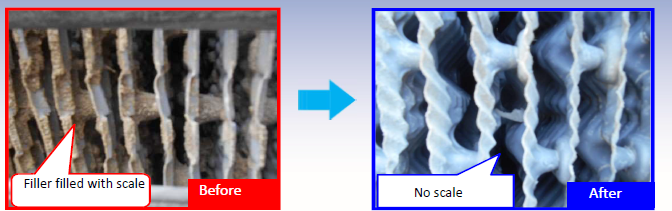
Scale Removal by using WTS

- Red Rust exists as Fe2O3(Ⅲ) in water
- The treated water with our device reacts and is reduced into Fe(OH)2 as follows:
H+ + O2 + e- → HO2
Fe(OH)3 + HO2 → Fe(OH)2+H2O+O2
- Red rust is dissolved by activated water and reduced Fe(OH)2 is combined with
Fe(OH)3,and it makes black rust asFe(OH)8 in water.
- Fe(OH)2 + 2Fe(OH)3 → Fe(OH)8 (Black rust in water)
- → 4 H2O +FeO4 (Black rust in the air)
Scale issues have been one of the most serious waters related issues. The causes for the formation of scales are ionized minerals like Si, Ca and Mg ( the ultimate cause for the formation of scales, particularly “ionized Silica can be a big cause”), oxidized iron & zinc and other impurities. Scale can be formed by the reaction of ionized minerals like Si, Ca and Mg with oxidized material including iron, zinc and other impurities. It is more possible for scales to be formed at a higher temperature and high PH.
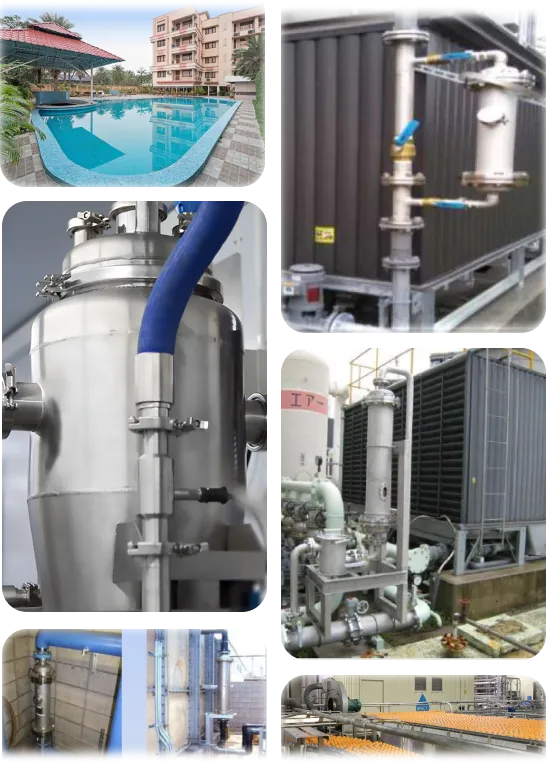
The conventional method for the solution of scales issue
Reduction of hardness of water !
It has been believed that reduction of hardness of water can solve the scale issues. And therefore, the parameters of the raw water (hardness) are always checked and some attempts to reduce hardness, namely, Ca and Mg ion are taken by RO or a Softener, though which cannot be so effective. Also, in some cases like RO, acid chemicals are used for water not to go Alkalized under the assumption that the formation of scales is likely to happen in higher pH which cannot be the case with WTS.
Is the above-mentioned approach effective in solving the scale issues?
A Common Misconception About Water Scaling
Many regions worldwide experience water with very low hardness levels – some areas having hardness below 100ppm or even as low as 50ppm in their tap water. Yet, surprisingly, scale formation remains a persistent problem even in these soft-water regions. This reveals a crucial insight: water hardness alone is not the ultimate determining factor in scale formation.
The Traditional Approach Falls Short
Traditional water treatment methods often focus solely on reducing water hardness. However, this approach overlooks a critical factor: ionized silica. Even when hardness is successfully reduced, scale problems persist because silica-based scaling isn’t addressed by conventional treatment methods. This oversight in traditional approaches has led to continued scaling issues despite water softening efforts
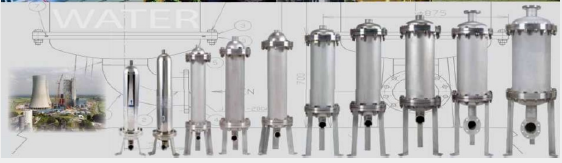
The Complete Solution
Effective scale prevention requires a comprehensive approach that addresses both hardness and silica-based scaling. By targeting all mineral constituents, including ionized silica, modern water enhancement technologies can provide complete protection against scale formation, regardless of the initial water hardness levels
Two types of scales in water
It should be noted that there are two types of scales, i.e. Silica scale and Calcium scale
Effect of Water eTech Solutions (WTS) on Slime and Rust
WTS can change/lower the electric potential of Fe and change FeO2 into FeO4
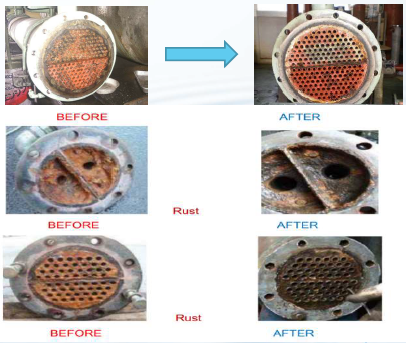
Major effects of WTS:
- Change the water structure making water molecules the smallest lower the surface tension of water which can cause significantly high osmotic pressure which can remove the exiting scales and rusts.
- Change ionized minerals like Si, Ca and Mg (the ultimate cause for the formation of scales ) into tiny soft colloids each of which is surrounded by a cationized water membrane. See the difference of the photos of mineral crystals in the next page.
- Provide the positive charge to water making a cationized water
At Water ETech Solutions (WTS), we are revolutionising how the world approaches water quality. Through sustainable innovation and proven efficiency, our solutions tackle global water challenges while delivering exceptional results for businesses and communities worldwide
Water ETech Solutions (WTS) pioneers innovative solutions that transform water quality and efficiency for businesses, governments, and households worldwide. Our cutting-edge technology delivers sustainable water enhancement without chemicals, making it ideal for both commercial and residential applications
WTS has the Following Advantages:
- 100% natural technology (chemical free!)
- No maintenance to be required (no replacement or recharge of the beads!)
- No power source to be required (no electricity required. Only water flows!)
- Long span of life of the products for over five (5) years.
- No waste of water (zero discharge or no backwash! )
- Many possible applications include domestic, agriculture, horticulture, water remediation, industrial and livestock. Improve the taste and quality of your drinking water.
- Reduce the scale of showers and corrosion around taps.
- Protect your skin from hard water.
- Cooling Tower
- No chemical feed to be required
- Much less blow down to be required
- No softener or RO to be required for makeup water
- Removal of the existing scales and no further formation of scales
- Increased efficiency of heat exchange
- Boiler
- Removal of the existing scales and no further formation of scales
- Increased heat efficiency
- Increased efficiency of fuel consumption
- No softener to be required
WTS also Solves the odor issue
- It is usually the case that the cause for bad odor in STP or polluted water zone is anaerobic fermentation of “flock “like Zoogloea which stays in the water.
- Micro-organism and organic matters can be dissolved by aerobic bacteria, however, due to the lack of the sufficient number of aerobic bacteria, there could remain such micro-organism or organic matters in water, which can pollute water causing bad odor.
- There are some cases where there could be some residues which have not been able to be resolved by aerobic bacteria even if there are enough aerobic bacteria in good amount of dissolved oxygen, and there could be anaerobic fermentation for such residuals so that it can cause a bad odor.
- Such fermented residues are called tiny flocks which are negatively charged. In STP, such tiny flocks can change into a bigger block by using flocculation agent under the conventional technology.
How can WTS solve such an odor issue?
- Cationized water by WTS
can make such tiny flocks into a mass of flocks without using flocculation agent since WTS water is positively charged so that it can absorb tiny flocks that are negatively charged efficiently. To remove bad odours, such a mass needs to be removed, ideally by a clarifier or a charcoal filter, which should be installed after WTS device. Thus, a mass of flock can be removed so that bad odour should be able to be eliminated. - How can WTS remove ammonia odour?
- WTS treated water is cationized water (positively charged), and therefore, it can absorb oxygen so easily, and as a result of it, DO (dissolved oxygen) can increase, which could lead to the proliferation of aerobic bacteria. An increased number of aerobic bacteria can resolve proteins of organic matter in water, changing them into ammonia. Ammonia (NH3) is positively charged; however, the hydrogen bond of NH3 is rather weak, so that WTS treated water can break such a hydrogen bond and absorb N (negatively charged), thereby ammonia odour can be removed.